Open-Cell vs. Closed-Cell Spray Foam: Which Is Right for Your St. George Home?
If you've started pricing out spray foam insulation for a home in St. George, Washington City, Hurricane, Santa Clara, or Ivins, you've probably run into two very different quotes for what sounds like the same product: open-cell and closed-cell spray foam. They are not the same material, they don't perform the same way, and using the wrong one in the wrong spot either wastes money or leaves performance on the table. This guide breaks down the real differences in plain terms — cost, R-value per inch, and how each behaves in our hot, dry desert climate — so you can walk into a decision with a clear head instead of guessing.
As a spray-foam-only specialist working exclusively in Washington County, we install both products every week and spec them differently depending on where they're going in the house. We're not a general insulation company that also does spray foam — spray foam is the only thing we do, which is why we do it better than anyone else in Washington County. That focus is exactly why we can give you a straight answer instead of a one-size-fits-all pitch.
The short version
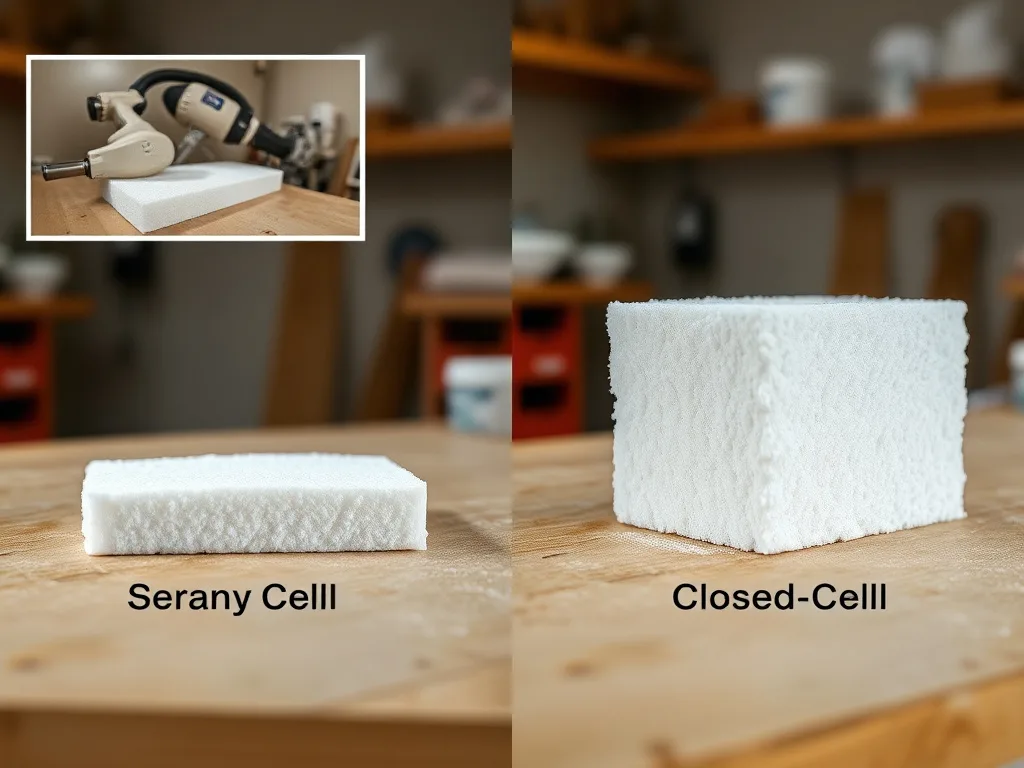
Open-cell spray foam is lighter, less expensive per board foot, and does an excellent job of air-sealing interior spaces like wall cavities and the underside of a non-roof-deck attic floor. Closed-cell spray foam is denser, costs more, delivers roughly double the R-value per inch, and adds rigidity and moisture resistance — which matters most where foam is applied against a roof deck, a rim joist, or in a crawl space that's exposed to ground moisture and monsoon-season humidity. Neither one is universally "better." The right choice depends entirely on which assembly you're insulating.
Cost per square foot
Installed pricing for spray foam in the St. George market generally runs about $1.50 to $5.00 per square foot, with open-cell foam sitting at the lower end of that range and closed-cell foam at the higher end. The spread comes down to raw material cost, the density of the foam being sprayed, and how many passes/lifts are needed to reach the target thickness for the R-value you're after.
- Open-cell foam: lower material cost per board foot, expands more per unit of chemical, generally the more budget-friendly option for large open cavities like interior walls
- Closed-cell foam: higher material cost per board foot, denser and more labor-intensive to apply correctly, but you often need less overall thickness to hit the same R-value target
- Total project cost also depends on application area, assembly depth, accessibility (a tight crawl space costs more to work in than an open attic), and square footage
Because closed-cell foam packs more R-value into less material thickness, a straight per-square-foot comparison doesn't always tell the whole story — the real question is cost per R-value delivered for that specific assembly, which is why the application area matters as much as the price tag.
R-value per inch
This is the single biggest technical difference between the two products, and it's not a small gap.
- Open-cell spray foam: approximately R-3.5 to R-3.7 per inch
- Closed-cell spray foam: approximately R-6 to R-7 per inch
Closed-cell foam is roughly twice as effective per inch of thickness. In a deep cavity — a 2x6 or 2x8 wall, a thick roof deck assembly, or a rim joist band — that difference lets closed-cell foam hit code-minimum or above-code R-values (2021 IECC Zone 3B targets typically run R-38 to R-49 in the attic and R-13 to R-21 in walls, depending on assembly) in less physical space than open-cell foam would need. In a shallow cavity, that density advantage can be the deciding factor.
Moisture behavior in a hot desert climate
St. George sits at roughly 2,860 feet elevation in a genuine hot desert climate — IECC Zone 3B — with July highs typically running 104-106°F and August close behind at around 102°F. Multi-week stretches above 100°F are completely normal from mid-June through early September. Because the air here is dry most of the year, open-cell foam's lower moisture resistance is rarely the liability it would be in a humid climate. Open-cell foam is vapor-permeable, which actually lets wall assemblies dry out in both directions if any incidental moisture does get in — a genuine advantage in the right application.
Closed-cell foam's tighter cell structure makes it far less absorbent and much better suited to any assembly that's in contact with the ground, near grade, or exposed to bulk water intrusion during a monsoon downpour. It also adds meaningful structural rigidity, which matters at a rim joist where the foam is helping stiffen a chronic air-leak point at the foundation perimeter.
A simple decision framework by application area
Rather than trying to memorize technical data sheets, most Washington County homeowners find it easier to think in terms of where the foam is going. Here's how we typically spec each application:
- Interior wall cavities — open-cell is usually the right call. It air-seals effectively, costs less, and the assembly isn't exposed to ground or exterior moisture, so open-cell's lower moisture resistance is a non-issue.
- Attic floor / non-roof-deck attic work — open-cell is often the more economical choice when you're insulating the attic floor rather than converting the attic into conditioned space.
- Roof deck (sealed/conditioned attic) — closed-cell is the better fit. It's taking direct desert heat load, benefits from the higher R-value per inch in a fixed rafter depth, and its rigidity helps the assembly hold up over time.
- Rim joist / band joist — closed-cell is the right choice. This is a chronic air-leak point at the foundation perimeter, and closed-cell's moisture resistance and rigidity handle monsoon-season dust, debris, and humidity infiltration far better than open-cell.
- Crawl space — closed-cell is strongly preferred given ground-radiated moisture and monsoon-season intrusion risk.
- Garage — depends on the assembly and whether the garage shares a wall or ceiling with conditioned living space; this is worth a quick on-site look rather than a blanket rule.
Notice the pattern: anything facing the exterior envelope directly — a roof deck, a rim joist, a crawl space — leans closed-cell because of heat load, rigidity, or moisture exposure. Anything interior and enclosed — a standard wall cavity — leans open-cell because you get effective air-sealing at a lower cost without any real moisture downside in our dry climate.
Why the right mix matters more than picking one product for the whole house
A lot of calls start with "which one should I use for my whole house?" — and the honest answer is usually both, applied to the right areas. Most full-home jobs in St. George end up using open-cell in the walls and attic floor while reserving closed-cell for the roof deck, rim joist, and crawl space. That mix keeps costs reasonable where it doesn't matter and puts the higher-performing product exactly where heat load and moisture exposure demand it. It's also where a spray-foam-only crew earns its keep — because it's all we do, we can walk a roof deck or crawl space and tell you in minutes which product belongs there and why.
Get a straight answer for your assemblies
Every home is a little different — rafter depth, wall assembly, crawl space height, and how exposed a given area is to monsoon-season moisture all factor into the right product mix. If you want a specific recommendation instead of a generic rule of thumb, call us at 844-967-5247 or email josh@contractorschoiceagency.com and we'll walk through your specific application areas with you.
Frequently asked questions
Yes, and it's actually the norm rather than the exception. Most full-home jobs in the St. George area use open-cell in interior wall cavities and the attic floor, then switch to closed-cell for the roof deck, rim joist, and crawl space where heat load and monsoon-season moisture exposure are higher.
Not in our climate. St. George is a hot desert climate with low ambient humidity most of the year, so open-cell's lower moisture resistance rarely becomes a liability in interior applications like wall cavities. The one caveat is monsoon season (mid/late-July through early/mid-September), which is why we still steer moisture-exposed areas like crawl spaces and rim joists to closed-cell regardless of season.
Closed-cell foam is a denser material that costs more per board foot and is more labor-intensive to apply at the correct thickness. In exchange, it delivers roughly double the R-value per inch of open-cell foam, along with added rigidity and moisture resistance — which is why it's worth the added cost specifically in roof deck, rim joist, and crawl space applications.
It depends on the specific assembly — whether the garage shares a wall or ceiling with conditioned living space, and how much direct heat load the space takes on. Garages here regularly exceed 120-130°F in summer, so the right product often comes down to a quick on-site look rather than a one-size-fits-all answer.
Ready for a free quote?
Tell us about your home and we'll build a clear, no-pressure quote.