Wall Cavity Spray Foam Insulation
Spray foam wall cavity insulation that seals gaps, stops convective air movement, and blocks radiant heat gain on the west and south walls that take the worst of the St. George summer sun.
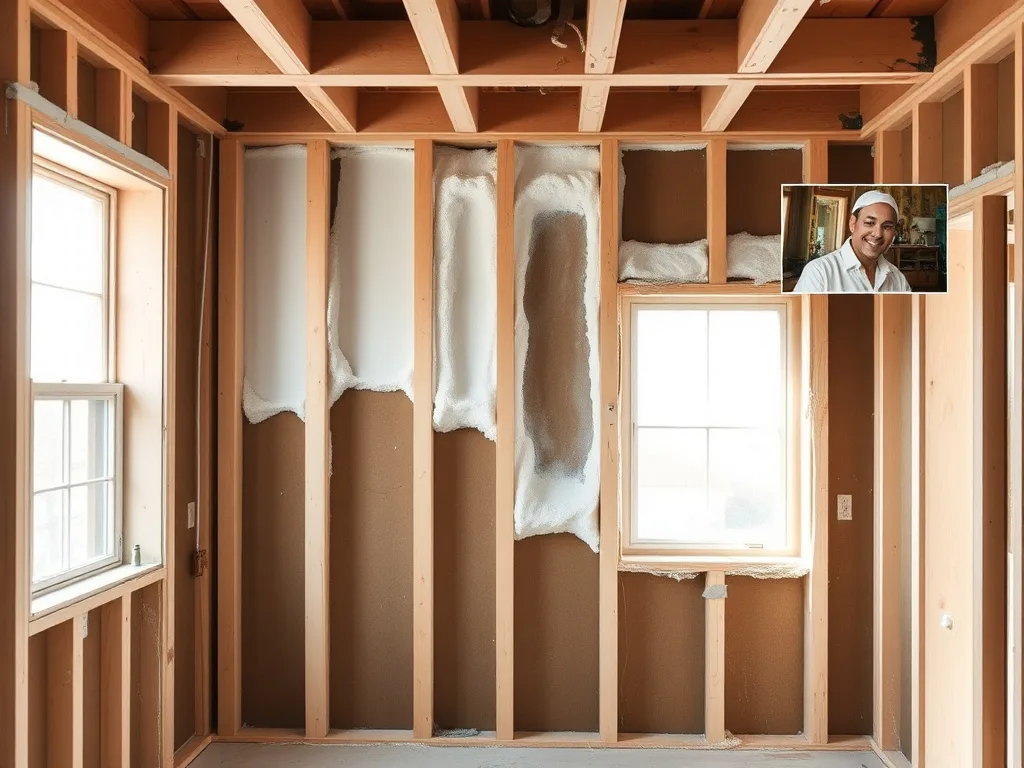
If there's one room in a St. George house that starts every conversation about insulation, it's the west-facing bedroom that's still hot at ten o'clock at night. The sun set hours ago, the thermostat says the house is at 74°F, and that one wall still radiates heat like a low-grade space heater. That's not a broken AC problem. That's a wall cavity problem, and it's one of the most common calls we get across St. George, Washington City, Hurricane, Santa Clara, and Ivins.
Exterior walls that face west and south in a Climate Zone 3B desert take a brutal, one-sided heat load for six to eight hours a day, five months a year. Standard fiberglass batt insulation was never designed to stop that kind of sustained radiant and conductive heat transfer, and by the time a home is ten or fifteen years old, the batts installed at construction are usually compressed, gapped, or partially fallen inside the cavity anyway. The wall looks insulated on paper. In practice, it's leaking heat through every void, every stud bay with slumped batting, and every gap around outlets, plumbing penetrations, and top and bottom plates.
Spray foam wall cavity insulation solves this differently than batts ever could. Instead of a friction-fit material that depends on perfect installation and stays perfect forever, spray foam expands to fill the entire cavity, adheres to the framing, and forms a continuous air seal in a single application. There are no gaps because there's nowhere for a gap to form. That's the difference between a wall that fights the desert sun all summer and a wall that simply stops transmitting the heat in the first place.
We are a spray-foam-only insulation contractor. We don't install blown-in fiberglass, we don't sell batt replacement as a standalone service, and we don't run energy audits or rebate paperwork as a side business. Spray foam is the only thing we do, which is why we do it better than anyone else in Washington County. When you call us about a hot wall, you're talking to the crew that thinks about wall cavity thermal performance all day, every day — not a general insulation company running spray foam as one line item among a dozen others.
Why homeowners choose it
- Stops west and south-facing wall heat gain at the source instead of just adding thermal mass that eventually saturates and re-radiates heat into the room
- Air-seals the entire cavity in one application, closing the gaps around outlets, top plates, and plumbing penetrations that fiberglass batts never fully cover
- Adds real structural rigidity to the wall assembly when closed-cell foam is used, unlike batts which offer zero racking resistance
- Eliminates the convective air movement inside the wall cavity that lets hot attic and exterior air currents carry heat directly into living space
- Reduces AC runtime and Rocky Mountain Power or Dixie Power summer bills by cutting the single biggest source of afternoon and evening heat load in most St. George homes
- Performs consistently for the life of the wall assembly instead of degrading the way compressed or settled fiberglass batts do within a decade of installation
Why West and South Walls Take the Worst of It
In St. George's Climate Zone 3B desert climate, wall orientation matters as much as wall construction. A north-facing wall gets indirect light for most of the day. A west-facing wall gets several hours of low-angle, high-intensity summer sun in the late afternoon and early evening — exactly the hours when the rest of the house is already at its hottest and the AC system is working hardest. South-facing walls take a longer, more direct exposure through the middle of the day, June through September.
That exposure doesn't stop at the stucco or siding. Exterior wall assemblies absorb solar radiation, and that heat conducts through the sheathing and into the stud cavity. If the cavity is filled with fiberglass batts that have gaps, compression, or convective air currents moving through them, that heat rides the air movement straight through to the interior drywall. This is why the classic complaint isn't "the whole house is hot" — it's "this one wall, this one room, stays hot for hours after sundown," because the wall itself has been storing and releasing heat all day.
Spray foam changes the physics of that wall. Closed-cell foam in particular has a higher R-value per inch (roughly R-6 to R-7) than fiberglass, but the bigger factor is that it eliminates the air movement inside the cavity that carries heat by convection, not just conduction. A sealed, foam-filled wall simply doesn't transmit heat the same way a batt-and-air-gap wall does.
How Old Fiberglass Batts Actually Fail
Fiberglass batt insulation depends entirely on installation quality and staying exactly where it was placed. In theory, a batt fills the stud cavity edge to edge with no gaps. In practice, almost no batt installation in a production-built home achieves that, and even a well-installed batt degrades over years.
The most common failure modes we see opening up walls across Washington County are consistent: batts compressed by wiring, plumbing, or electrical boxes that were never notched around properly, leaving thin spots with a fraction of the rated R-value; batts that have settled or slumped over time, especially in taller wall cavities, leaving an uninsulated gap at the top of the stud bay; batts cut too small or too loosely fit around window and door framing, leaving continuous air gaps at exactly the points where air infiltration matters most; and batts that were simply never fully seated against the exterior sheathing, leaving an air space that lets convective currents move heat around the insulation instead of through it.
None of these failures are visible from inside a finished room. The drywall looks fine, the wall looks insulated, and the only symptom is the one that brought most customers to us in the first place: a wall or room that runs hotter than it should, no matter what the thermostat says. Spray foam removes the failure mode entirely because there's no batt to compress, settle, or gap — the foam expands to fill whatever space is actually there.
The 'Why Does My West-Facing Bedroom Stay Hot All Evening' Answer
This is close to a word-for-word question we hear from homeowners across St. George, Hurricane, and Santa Clara, and the answer is almost always the same: the wall assembly is storing heat all afternoon and releasing it into the room for hours after the sun goes down, because the insulation inside that cavity isn't stopping conductive and convective heat transfer the way it should.
It plays out on a predictable schedule. By early afternoon, direct sun is hitting the west wall and heat is building in the stucco, sheathing, and stud cavity. By evening, even after the sun is down and outdoor temperatures have dropped, that wall assembly is still radiating stored heat into the room, and the AC vent in that room is running constantly trying to keep up. Homeowners often assume this means their air conditioner is failing or undersized. In the majority of cases we inspect, the AC is doing exactly what it should — it's fighting a wall that was never built to stop this kind of heat load in the first place.
Sealing that wall cavity with spray foam addresses the actual cause instead of asking the AC system to compensate for a losing battle every single evening from June through September.
Open-Cell vs. Closed-Cell for Wall Cavities
Both open-cell and closed-cell spray foam work in wall cavities, and the right choice depends on the wall's construction, orientation, and what's already inside it. Open-cell foam is a lower-cost, still highly effective air-sealing option for standard interior stud-bay applications where the wall isn't taking direct, sustained exterior heat load — it fills the cavity, stops air movement, and performs well at roughly R-3.5 to R-3.7 per inch. In St. George's dry desert climate, open-cell's lower moisture resistance is rarely a practical liability the way it can be in humid regions.
Closed-cell foam is the better fit for west and south-facing exterior walls taking the most direct desert sun, and for any wall assembly where structural rigidity and higher R-value per inch matter — rim areas, exterior-adjacent cavities, and walls that also need added resistance to monsoon-season wind-driven moisture. At roughly R-6 to R-7 per inch, closed-cell delivers meaningfully more thermal resistance in the same cavity depth, which matters most on the walls doing the heaviest work against summer heat gain.
We walk every homeowner through this decision on-site, looking at actual wall orientation, existing cavity condition, and budget, rather than defaulting to one product for every wall in the house.
What the Wall Cavity Process Looks Like
Wall cavity spray foam is most straightforward when the cavity is already open — during a remodel, an addition, a re-stucco project, or drywall replacement after damage. In those cases, we inspect the existing framing and any remaining batt material, remove degraded insulation where needed, and spray the cavity to full depth in a single controlled application, leaving a clean, code-compliant surface ready for drywall or the next trade.
For homes where walls are finished and closed, retrofit wall cavity foam is typically done through a small-diameter injection process from the exterior or interior, filling the existing cavity around existing materials. We'll assess feasibility on-site and recommend the approach — new cavity fill or injection retrofit — that fits the specific wall assembly in your home.
In every case, our focus stays narrow and specific: spray foam application done right, not a broader insulation or remodeling scope. That's the advantage of working with a spray-foam-only specialist instead of a general contractor adding foam as one more service line.
Ideal for
- Homeowners whose west or south-facing bedroom or living room stays noticeably hotter than the rest of the house through the evening
- Older St. George-area homes where original fiberglass batt insulation has visibly settled, compressed, or fallen away from framing
- New wall assemblies during a remodel, addition, or exterior re-stucco project where the cavity is already open
- Homeowners replacing drywall after water damage, remodeling, or renovation who want to upgrade the wall's thermal performance while the cavity is exposed
- Homes with visible temperature differences room-to-room that point to uneven wall performance rather than an undersized or failing AC system
- Builders and remodelers in Washington Fields, Little Valley, Desert Color, and other growth corridors looking to exceed code-minimum wall R-values
What affects the cost
Wall Cavity Spray Foam questions, answered
In the large majority of cases we inspect, the AC system is sized correctly and is simply being asked to fight a wall assembly that's storing and radiating heat all afternoon and evening. Sealing that wall cavity with spray foam addresses the actual heat source rather than the AC's ability to keep up with it. We're happy to do an on-site assessment before you spend money on HVAC changes that may not solve the underlying problem.
It depends on the batt's condition. Degraded, compressed, or fallen batt material is removed before we spray so the foam can properly fill and seal the full cavity. We don't install fiberglass ourselves — as a spray-foam-only contractor, our job in every wall is getting foam properly applied, not managing a mixed-material insulation system.
Yes, in many cases. We use an injection process that fills existing wall cavities without removing the drywall, though feasibility depends on the specific wall construction and what's already inside the cavity. If a wall is being opened for another reason — remodel, addition, damage repair — that's typically the most cost-efficient time to add foam.
Not necessarily. Closed-cell makes the most sense on west and south-facing exterior walls taking the heaviest direct desert sun, where its higher R-value per inch and moisture resistance earn their higher cost. Open-cell is often the more economical, still effective choice for interior walls or less sun-exposed exterior walls. We'll recommend a mix based on your home's actual orientation, not a one-size answer.
Yes. We work with builders and general contractors in Washington Fields, Little Valley, Desert Color, and Hurricane to spray wall cavities to or above 2021 IECC Zone 3B code minimums in a single trade visit, which is a common request during the framing-to-drywall stage of new builds.
Wall Cavity Spray Foam done right, by a local Washington County crew
We're a spray-foam-only specialist — not a general insulation contractor that also offers spray foam as one option among many. Wall Cavity Spray Foam isn't a commodity, and the result depends entirely on how carefully it's scoped and installed for your specific home in a genuine hot-desert climate. We assess what your house actually needs, prep and air-seal properly, and install to your elevation-appropriate, IECC Zone 3B R-value target, so the work delivers the cooling-bill relief it's supposed to.
We serve St. George, Washington City, Hurricane, Santa Clara, Ivins, LaVerkin, and Toquerville. St. George's summers are the whole story here — dark roof decks push attic temperatures to 130-150°F+ from May through September, and that heat radiates straight down into living space and forces your AC to run nearly nonstop. We scope every job around that cooling load, not around a heating-season assumption borrowed from a colder climate. Every job starts with a free, no-pressure quote.
Just as important, we treat your home like the system it is. Insulation, air sealing, and ventilation all interact, and getting one right while ignoring the others leaves comfort and savings on the table. When we scope your wall cavity spray foam, we look at how it fits the whole picture — so the finished result performs the way it should, holds up through a genuine St. George summer, and actually lowers the AC bills you feel every month, whether you're served by Rocky Mountain Power (including its Wattsmart Homes program) or Dixie Power.
Free assessment
We evaluate your home and give you a clear, itemized quote.
Expert install
We prep, air seal, and install your wall cavity spray foam to spec — clean and on schedule.
Savings you can feel
A cooler home, lower AC bills, and honest advice about what your home needs.
Related services
Ready for a free wall cavity spray foam quote?
Tell us about your home and we'll put together a clear, no-pressure spray foam insulation quote — built for St. George's real summers.