Rim Joist / Band Joist Spray Foam Insulation
Closed-cell spray foam applied directly to the rim joist / band joist cavity — the narrow strip of framing where your foundation meets your floor system — closing off one of the most overlooked air-leak points in any St. George home.
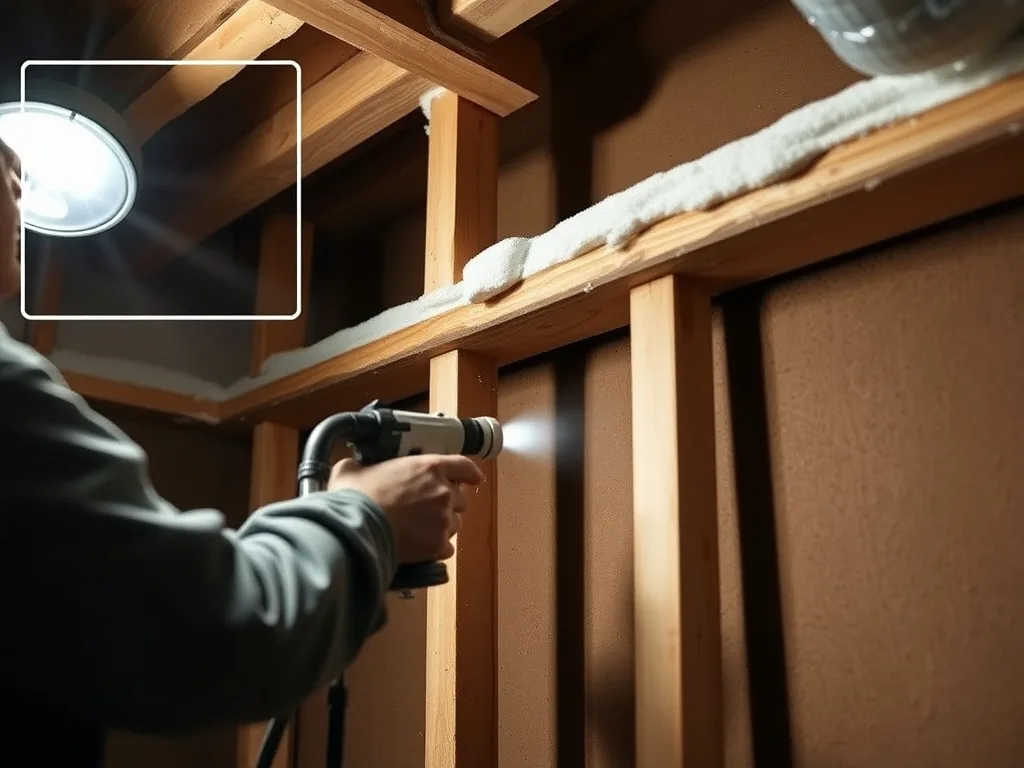
If you've ever crawled under your house on a July afternoon and felt a wall of hot, dusty air pouring in around the edge of the foundation, you've met the rim joist. Also called the band joist, this is the narrow ribbon of framing that sits directly on top of your foundation wall, running the entire perimeter of your home and forming the outer edge of every floor system above a crawl space or basement. It's where the wood framing of your house meets the concrete or block of your foundation — and in most homes built in Washington County, that seam was never properly sealed in the first place.
Builders typically leave this cavity insulated with a thin batt of fiberglass stapled or friction-fit between the joists, if it's insulated at all. Fiberglass batts don't stop air movement — they only slow heat conduction — so the rim joist band stays one of the leakiest, most drafty sections of the entire building envelope. In a hot desert climate like ours, that means two things happen at once: superheated air from outside the crawl space or exterior wall cavity gets pulled in through every gap, and during monsoon season, wind-driven dust and fine debris rides right along with it, settling into ductwork, crawl spaces, and stored belongings.
Sealing the rim joist with closed-cell spray foam solves both problems in a single application. The foam expands to fill every irregular gap between the joists, sill plate, and foundation — sealing around plumbing penetrations, wiring runs, and the uneven lumber cuts that batts can never conform to — and it stays sealed permanently, with no settling, sagging, or gapping over time.
This is one of the fastest, most cost-effective upgrades we install. Because the rim joist band is a short, defined run of cavities rather than an entire attic or crawl space, most jobs take a fraction of the time of a full attic or crawl space project — which is exactly why we build it as a standard add-on whenever we're already on-site for an attic or crawl space job. If our crew is already mobilized at your property, sealing the rim joist band while we're there is the single best dollar-for-dollar upgrade available, because the setup and travel cost is already covered by the primary job.
As always, this is the only thing we do. We're not a general insulation company that also does spray foam — spray foam is the only thing we do, which is why we do it better than anyone else in Washington County. Every rim joist job we run uses the same closed-cell material and application standards as our flagship attic and roof-deck work, applied by the same crew, with no subcontracted batt-and-caulk shortcuts.
Why homeowners choose it
- Closes the single leakiest seam in most homes — the joint where foundation meets floor framing, sealed continuously around plumbing and wiring penetrations
- Stops hot, dust-laden desert air from infiltrating crawl spaces and wall cavities, reducing the dust load your HVAC system and air filters have to fight
- Blocks monsoon-season wind-driven grit and debris from working its way into the crawl space and up into the living space above
- Closed-cell foam adds rigid structural bracing to the rim joist assembly, stiffening a section of framing that's often exposed to moisture and movement
- Reduces floor-level drafts and cold-feeling floors near exterior walls that homeowners often mistake for a furnace or ductwork problem
- One of the most efficient upgrades per dollar spent — a short, defined cavity run means low material and labor cost relative to the air-sealing impact
Why the Rim Joist Is a Chronic Air-Leak Point
The rim joist sits at a structural transition — foundation to framing — where multiple building trades meet: the foundation crew pours the wall, the framing crew sets the sill plate and joists, and the plumbing and electrical trades punch through with pipes and wire runs. Every one of those transitions creates a gap that's difficult to seal with conventional materials, and in practice, most of them never get sealed at all beyond a bead of caulk that shrinks and cracks within a few years.
Because the rim joist band runs the full perimeter of the house, even small gaps add up to a large total leak area — often rivaling or exceeding the air leakage from an unsealed attic hatch or an old exterior door. Energy auditors consistently flag the rim joist as one of the top three air-leak locations in a typical home, right alongside the attic and the areas around recessed lighting.
- Sill plate to foundation wall gap, often visible as a continuous crack around the entire perimeter
- Joist-to-joist gaps where batt insulation was friction-fit and has since settled or been disturbed
- Plumbing and electrical penetrations that were never caulked or foamed after rough-in
- Corner and transition framing where cavity shapes are irregular and standard batts can't conform
Stopping Hot-Air Infiltration in a Desert Climate
In St. George's climate, the rim joist doesn't just leak conditioned air out — it lets superheated, exterior-temperature air in, all summer long. With crawl space and exterior wall cavity temperatures climbing well above 100°F for weeks at a time between June and September, an unsealed rim joist band acts like a heat pipe running the entire perimeter of the house, feeding hot air directly into the floor system and up into interior wall cavities.
That infiltration works against your air conditioning system continuously, not just during the hottest part of the day. Because the leak path is passive and constant, it adds a steady, low-grade cooling load that doesn't show up as a single dramatic problem — it shows up as an AC system that runs longer than it should and utility bills that stay stubbornly high even after other upgrades. Sealing the rim joist band with closed-cell foam closes that path completely, which is why it pairs so well with attic sealing: together they address the two biggest passive heat-infiltration points in the home.
Blocking Monsoon Dust and Debris Infiltration
Washington County's monsoon season, running from mid/late July through early or mid-September, brings more than just humidity spikes and flash-flood risk — it brings sustained periods of wind-driven dust and fine debris. That dust doesn't stay outside. It finds every unsealed gap in the building envelope, and the rim joist band, with its continuous run of small, irregular openings around the entire foundation perimeter, is one of the primary entry points.
Once dust gets into the crawl space through the rim joist, it doesn't stay contained down there. Air pressure differences pull it up through floor penetrations, gaps around plumbing stacks, and any other opening between the crawl space and the living space above, where it ends up in HVAC returns, on interior surfaces, and in air filters that need changing far more often than they should. A properly sealed rim joist band stops that infiltration path at its source instead of trying to filter it out after the fact.
The Easiest Upsell to Your Attic or Crawl Space Job
Most homeowners never think about the rim joist band on its own — it's not a room you use, and it's not visible unless you're crawling around under the house. But because we're already on-site sealing an attic or crawl space, adding the rim joist band to the scope of work is the single most efficient upgrade we can offer. There's no additional mobilization, no separate service call, and no duplicated setup cost.
The material and labor required to seal a rim joist run are modest compared to a full attic or crawl space job, which means the incremental cost is low relative to the amount of leak area closed. We'll walk the rim joist perimeter during your attic or crawl space estimate, point out any sections that are currently unsealed or poorly insulated, and give you a straightforward add-on price — no pressure, no separate trip required.
- Bundled with an attic spray foam job: rim joist sealing is completed from inside the accessible framing bays before or after the main attic work
- Bundled with a crawl space spray foam job: the rim joist band is sealed as a natural extension of the crawl space perimeter work
- Standalone rim joist jobs are available for homes that aren't scheduling a larger project but have a known leak or dust problem at the foundation perimeter
Why Closed-Cell Foam Is the Right Material for This Cavity
The rim joist band takes direct exposure to exterior temperature swings, occasional moisture from grade-level splash-back or monsoon runoff, and structural loads transferred from the foundation to the floor framing above. Closed-cell spray foam, at roughly R-6 to R-7 per inch, is the higher-density, higher-R-value option in our lineup, and it's the material we use for every rim joist job because it matches all three of those demands: it delivers strong R-value in a thin cavity, it adds rigid structural bracing to the joist bay, and its closed-cell structure resists moisture uptake far better than an open-cell product would in an exterior-adjacent assembly.
This is the same reasoning that guides our material choice on roof decks and other exterior-adjacent assemblies across every job we run — closed-cell where the cavity faces direct exterior exposure or takes a structural role, open-cell where the assembly is fully interior and moisture exposure isn't a factor.
Ideal for
- Homes with a crawl space foundation where the rim joist band is currently bare or covered only with fiberglass batts
- Homeowners already scheduling an attic or crawl space spray foam job who want to seal the rim joist band in the same visit
- Houses in Washington City, Hurricane, Santa Clara, Ivins, or St. George with noticeably dusty crawl spaces after monsoon season
- Rooms with cold or drafty floors near exterior walls, especially over unconditioned crawl spaces
- New construction and remodel projects where the rim joist is exposed and accessible before drywall or finish work goes in
- Homeowners who've already addressed attic insulation but still notice utility bills or comfort issues tied to the lower level of the home
What affects the cost
Rim Joist / Band Joist questions, answered
It's the horizontal framing member that sits directly on top of your foundation wall, running around the entire perimeter of the house and forming the outer edge of your floor system. It's the transition point between the foundation and the wood framing above, and it's typically only accessible from inside a crawl space or basement.
Yes. While it's most efficient as an add-on to an attic or crawl space project, we also run standalone rim joist jobs for homeowners who have a known dust, draft, or air-leak problem at the foundation perimeter and aren't ready for a larger project.
It addresses one of the primary entry points. If dust is getting into your crawl space through an unsealed rim joist band and then working its way up into the living space, sealing that seam closes off that specific infiltration path. It won't eliminate every source of household dust, but it removes a major contributor, especially during monsoon season.
Batts slow heat conduction but do nothing to stop air movement, and the irregular shape of rim joist cavities — with plumbing penetrations, wiring, and uneven lumber — means batts rarely fit tightly enough to make real contact with the framing. Closed-cell spray foam expands to fill every gap and seals the air leak completely, which is the actual problem in this cavity.
As a standalone job, most homes are completed in a matter of hours, since the rim joist band is a short, defined run of cavities rather than an entire attic or crawl space. When it's bundled with a larger attic or crawl space job, it typically adds only a modest amount of time to the overall visit.
Rim Joist / Band Joist done right, by a local Washington County crew
We're a spray-foam-only specialist — not a general insulation contractor that also offers spray foam as one option among many. Rim Joist / Band Joist isn't a commodity, and the result depends entirely on how carefully it's scoped and installed for your specific home in a genuine hot-desert climate. We assess what your house actually needs, prep and air-seal properly, and install to your elevation-appropriate, IECC Zone 3B R-value target, so the work delivers the cooling-bill relief it's supposed to.
We serve St. George, Washington City, Hurricane, Santa Clara, Ivins, LaVerkin, and Toquerville. St. George's summers are the whole story here — dark roof decks push attic temperatures to 130-150°F+ from May through September, and that heat radiates straight down into living space and forces your AC to run nearly nonstop. We scope every job around that cooling load, not around a heating-season assumption borrowed from a colder climate. Every job starts with a free, no-pressure quote.
Just as important, we treat your home like the system it is. Insulation, air sealing, and ventilation all interact, and getting one right while ignoring the others leaves comfort and savings on the table. When we scope your rim joist / band joist, we look at how it fits the whole picture — so the finished result performs the way it should, holds up through a genuine St. George summer, and actually lowers the AC bills you feel every month, whether you're served by Rocky Mountain Power (including its Wattsmart Homes program) or Dixie Power.
Free assessment
We evaluate your home and give you a clear, itemized quote.
Expert install
We prep, air seal, and install your rim joist / band joist to spec — clean and on schedule.
Savings you can feel
A cooler home, lower AC bills, and honest advice about what your home needs.
Related services
Ready for a free rim joist / band joist quote?
Tell us about your home and we'll put together a clear, no-pressure spray foam insulation quote — built for St. George's real summers.