Attic & Roof-Deck Spray Foam Insulation
We convert your vented attic into a sealed, conditioned assembly by spray foaming the underside of the roof deck — stopping desert heat at the source instead of fighting it once it's already inside your home.
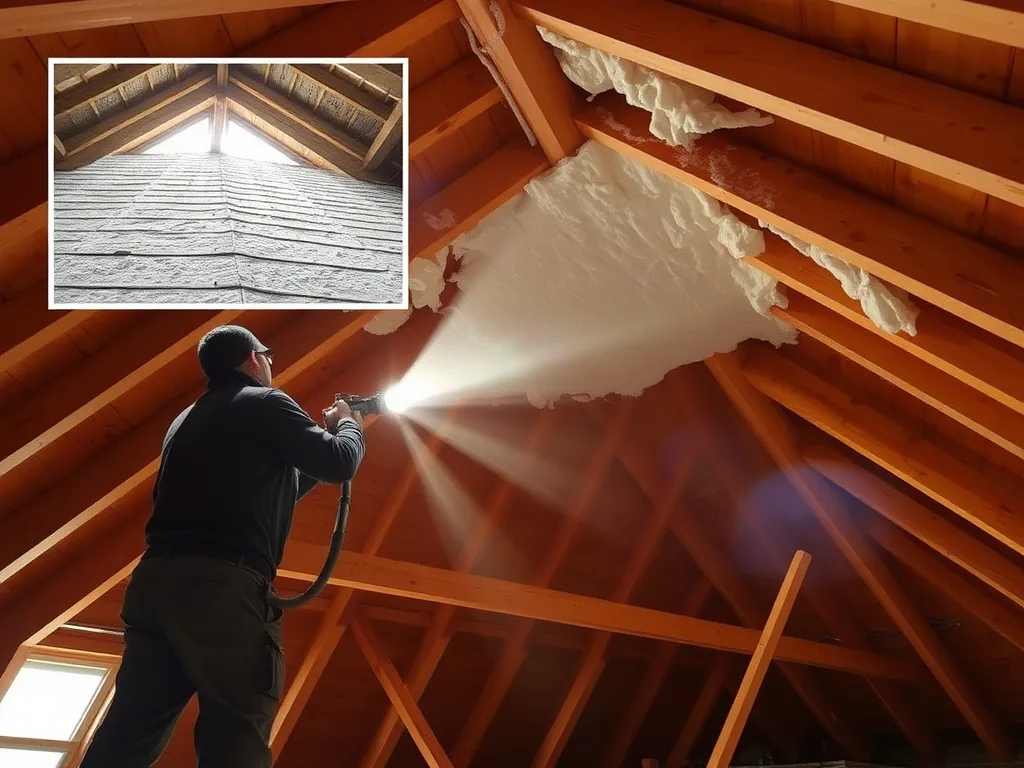
If you've ever climbed into your attic on a July afternoon in St. George, you already know the number that matters here: 130 to 150°F or hotter, radiating off the underside of a sun-baked roof deck. That heat doesn't stay in the attic. It soaks into ductwork, drives straight through drywall and ceiling joists, and turns your air conditioner into a machine that runs almost nonstop from May through September just to keep up.
Attic and roof-deck spray foam insulation is the single highest-impact service we install, which is why it's our flagship offering. Instead of laying more fiberglass or blown-in material on the attic floor — which does nothing to stop a 150°F roof deck from radiating heat downward onto your ducts — we spray closed-cell or a hybrid foam system directly to the underside of the roof deck itself. That one change converts a traditional vented attic into an unvented, sealed, conditioned-space assembly, and it's the difference between an attic that behaves like a pizza oven and one that tracks close to your home's indoor temperature.
We're not a general insulation company that also does spray foam — spray foam is the only thing we do, which is why we do it better than anyone else in Washington County. Every crew member who climbs into your attic has done nothing but spray foam applications, day in and day out, across St. George, Washington City, Hurricane, Santa Clara, and Ivins.
Why homeowners choose it
- Eliminates the 130-150°F hot-roof-deck effect that radiates through ductwork and ceilings all summer
- Converts a vented attic into a sealed, conditioned assembly — no more attic-to-living-space heat transfer
- Lowers Rocky Mountain Power and Dixie Power summer bills by reducing AC runtime and short-cycling
- Keeps supply-air temperature colder at the register instead of losing it to a superheated attic on the way there
- Closed-cell foam adds rigidity to the roof structure and resists monsoon-season moisture intrusion
- One-time air-seal-plus-insulate application instead of loose-fill material that settles, shifts, or gets kicked around by attic HVAC work
The Hot Roof Deck Problem
St. George sits in IECC Climate Zone 3B, a genuine hot desert climate with summer highs of 104-106°F in July and stretches of 100°F+ weather that routinely run from mid-June into early September. Direct desert sun hitting a dark asphalt or shingle roof pushes the roof deck itself — the plywood or OSB sheathing your shingles are nailed to — to 130°F, 140°F, sometimes north of 150°F on the worst afternoons.
In a traditional vented attic, that superheated roof deck sits just inches above your attic floor insulation and, in most homes, just inches above exposed HVAC ductwork and ceiling joists. Heat radiates downward all day and keeps radiating into the evening as the roof deck slowly gives up stored heat after sunset. Attic-floor insulation alone does very little to stop this, because the problem isn't just heat moving through the ceiling — it's your ductwork sitting inside what is effectively a convection oven for six months a year, and every degree of heat gain into that duct system is heat your AC has to remove twice: once when it enters the duct, and again when it finally reaches the room.
- Roof deck surface temps: 130-150°F+ on direct-sun summer afternoons
- Heat radiates directly onto ductwork and ceiling drywall below
- Traditional attic-floor insulation does not address radiant heat gain at the deck itself
- Monsoon-season humidity (mid/late-July through early/mid-September) compounds moisture stress on a hot, poorly sealed attic
From Vented Attic to Sealed, Conditioned Assembly
The fix isn't more material on the attic floor — it's moving the thermal and air barrier up to the roofline. We spray closed-cell foam (or a closed-cell/open-cell hybrid, depending on your roof assembly and code requirements) directly against the underside of the roof deck and up the gable ends, sealing the entire attic into the home's conditioned envelope rather than leaving it vented to outside air.
Once that roof deck is foamed, it stops behaving like a solar collector and starts behaving like part of your home's thermal envelope. Attic temperatures in a properly sealed assembly typically track much closer to indoor conditions instead of spiking 60-80 degrees above them. Your ductwork, which used to sit inside a 140°F attic, now sits inside a semi-conditioned space that might run 85-95°F on the hottest days — a massive difference in how much heat your supply air picks up before it ever reaches a register.
This is also where closed-cell foam's structural properties matter in a desert climate: it adds rigidity to roof sheathing, helps resist wind uplift, and — unlike loose-fill insulation — won't settle, shift, or blow around when monsoon storms drive wind-driven dust and debris through soffit and ridge vents that no longer exist once the assembly is sealed.
- Roof deck and gable ends sealed with closed-cell or hybrid spray foam
- Attic reclassified from vented, unconditioned space to sealed, semi-conditioned space
- Ductwork now operates inside a much cooler thermal environment year-round
- Air-seals against monsoon-driven dust, wind, and moisture intrusion at the same time
Spray Foam vs. Radiant Barrier: Which Actually Works Better
Radiant barriers — reflective foil sheeting stapled to rafters or laid over attic floor insulation — are a common suggestion for hot-climate attics, and they do provide a real but limited benefit: reflecting radiant heat rather than absorbing it. The problem is that a radiant barrier does nothing to air-seal the attic, doesn't stop conductive or convective heat transfer through gaps, vents, and penetrations, and provides zero R-value or structural benefit. It's a one-dimensional fix for a multi-dimensional heat problem.
Spray foam addresses radiant, conductive, and convective heat transfer simultaneously. It insulates (R-6 to R-7 per inch for closed-cell), air-seals every gap and penetration in one continuous application, and physically stops hot outside air from mixing with attic air in the first place. Where a radiant barrier might knock a few degrees off a 150°F attic, a properly sealed spray foam roof deck routinely keeps attic temperatures within 10-20 degrees of the conditioned space below it. For a Washington County home running AC five to six months a year, that's the difference between a marginal improvement and a fundamental change in how the whole roof assembly performs.
- Radiant barrier: reflects radiant heat only, no air-sealing, no R-value, no structural benefit
- Spray foam: insulates, air-seals, and blocks radiant/conductive/convective heat transfer in one application
- Radiant barrier attics still spike well above conditioned-space temperature on peak summer days
- Sealed spray foam roof decks keep attic temps far closer to indoor conditions
The Payoff: Lower Rocky Mountain Power and Dixie Power Summer Bills
Cooling load is the whole game in St. George, and your attic is usually the single biggest source of unnecessary cooling load in the house. When ductwork sits inside a 140°F+ attic, the AC system loses cooling capacity to duct heat gain before air ever reaches a room — meaning the unit has to run longer, cycle more, and work harder to hit the same thermostat setting than it would if that ductwork sat in a sealed, semi-conditioned attic.
Sealing the roof deck with spray foam directly reduces that duct heat gain and reduces the overall cooling load on the home, which shows up as reduced AC runtime on your Rocky Mountain Power or Dixie Power summer bill. Rocky Mountain Power customers may also want to check current eligibility under the Wattsmart Homes program, which has offered rebates tied to qualifying insulation upgrades — we can point you toward the current program details when we quote your job. Either way, this is the one insulation upgrade in a St. George home most directly tied to what you'll see on your July and August utility statement.
- Less duct heat gain means less cooling capacity lost between the AC unit and the register
- Reduced AC runtime and cycling directly lowers summer electric usage
- Rocky Mountain Power's Wattsmart Homes program may offer rebate eligibility — ask us for current details
- Dixie Power customers see the same runtime-reduction benefit reflected in summer usage
Why a Spray-Foam-Only Specialist Gets This Right
Attic and roof-deck conversions are the most technically demanding application we install — getting ventilation strategy, ignition-barrier requirements, and foam thickness right on a sealed assembly isn't something you want a generalist crew learning on your roof. Because spray foam is the only material we install, our crews spend every working day solving exactly this problem: how much foam, where, and with what assembly, to turn a specific St. George roof into a sealed, high-performing thermal envelope rather than a liability.
We serve St. George, Washington City, Hurricane, Santa Clara, and Ivins, with lighter service into LaVerkin and Toquerville. R-value targets follow the 2021 IECC Zone 3B code baseline — we typically recommend R-49 at the roof-deck/attic assembly as the safe, code-aligned target for this climate, adjusted to your specific roof structure and existing insulation.
- Spray-foam-only specialist crews — not a side service added to a general insulation lineup
- Every job assessed for correct foam type, thickness, and assembly-specific ventilation strategy
- Service area: St. George, Washington City, Hurricane, Santa Clara, Ivins, with lighter coverage in LaVerkin/Toquerville
- R-49 recommended target at the roof-deck assembly, aligned to 2021 IECC Zone 3B
Ideal for
- Homes where the upstairs or top-floor rooms stay noticeably hotter than the rest of the house
- Attics with exposed ductwork running through unconditioned, vented attic space
- Homeowners whose AC runs almost continuously June through September and still struggles to hold temperature
- Homes with dark or asphalt-shingle roofing that absorbs and radiates more desert heat
- New builds and re-roofs in Washington Fields, Little Valley, Desert Color, and Hurricane where the roof deck is accessible before insulation goes in
- Anyone comparing spray foam to a radiant barrier and wanting the higher-performing, permanent option
What affects the cost
Attic & Roof-Deck Insulation questions, answered
Yes — this is the most direct cooling-load reduction we can make on a typical Washington County home. Ductwork moving from a 130-150°F vented attic into a sealed, semi-conditioned attic loses far less cooling capacity in transit, which reduces AC runtime and shows up on your Rocky Mountain Power or Dixie Power summer bill.
No — that's the point of the conversion. Sealing the roof deck with spray foam moves the attic from a vented, unconditioned space to a sealed, conditioned assembly, so the old venting strategy is intentionally replaced rather than left in place.
We typically use closed-cell foam (roughly R-6 to R-7 per inch) or a closed-cell/open-cell hybrid at the roof deck, since closed-cell offers higher R-value per inch, added structural rigidity, and better resistance to monsoon-season moisture at the roofline.
A radiant barrier only reflects radiant heat and adds no air-sealing or R-value. Spray foam insulates, air-seals every gap in one application, and blocks radiant, conductive, and convective heat transfer together, which is why sealed spray foam attics run far closer to indoor temperature than radiant-barrier attics on peak summer days.
Per 2021 IECC Zone 3B, we recommend R-49 as the safe, code-aligned target for the attic/roof-deck assembly in St. George, adjusted for your specific roof structure. We'll confirm the exact figure for your home during the quote.
We install attic and roof-deck spray foam throughout St. George, Washington City, Hurricane, Santa Clara, and Ivins, with lighter coverage into LaVerkin and Toquerville. Call 844-967-5247 or email josh@contractorschoiceagency.com to check your address and schedule a quote.
Attic & Roof-Deck Insulation done right, by a local Washington County crew
We're a spray-foam-only specialist — not a general insulation contractor that also offers spray foam as one option among many. Attic & Roof-Deck Insulation isn't a commodity, and the result depends entirely on how carefully it's scoped and installed for your specific home in a genuine hot-desert climate. We assess what your house actually needs, prep and air-seal properly, and install to your elevation-appropriate, IECC Zone 3B R-value target, so the work delivers the cooling-bill relief it's supposed to.
We serve St. George, Washington City, Hurricane, Santa Clara, Ivins, LaVerkin, and Toquerville. St. George's summers are the whole story here — dark roof decks push attic temperatures to 130-150°F+ from May through September, and that heat radiates straight down into living space and forces your AC to run nearly nonstop. We scope every job around that cooling load, not around a heating-season assumption borrowed from a colder climate. Every job starts with a free, no-pressure quote.
Just as important, we treat your home like the system it is. Insulation, air sealing, and ventilation all interact, and getting one right while ignoring the others leaves comfort and savings on the table. When we scope your attic & roof-deck insulation, we look at how it fits the whole picture — so the finished result performs the way it should, holds up through a genuine St. George summer, and actually lowers the AC bills you feel every month, whether you're served by Rocky Mountain Power (including its Wattsmart Homes program) or Dixie Power.
Free assessment
We evaluate your home and give you a clear, itemized quote.
Expert install
We prep, air seal, and install your attic & roof-deck insulation to spec — clean and on schedule.
Savings you can feel
A cooler home, lower AC bills, and honest advice about what your home needs.
Related services
Ready for a free attic & roof-deck insulation quote?
Tell us about your home and we'll put together a clear, no-pressure spray foam insulation quote — built for St. George's real summers.